※本ページはプロモーションが含まれます
Disclosure: This post contains affiliate links. If you buy through them, we may earn a commission at no additional cost to you. Learn more.
Short answer: if you’re building a competitive deck, a starter deck (especially an EX starter with guaranteed Super Rares) usually gives you more usable value per dollar than gambling on a booster box. If you’re chasing alt-art chase cards for a binder or investment, only a booster box (or a Manga Booster) can get you there — a starter deck’s contents are fixed and never include a Secret Rare. And if you just want the most fun for the least money with a friend, two starter decks beat a box every time. The right buy really does depend on what you’re trying to get out of the purchase, so let’s run the actual math.
This isn’t a “starter decks are for beginners, boxes are for real players” argument — that’s outdated advice from card games with weaker preconstructed products. Fusion World’s starter decks, especially the newer “EX” line, are built differently than a decade of Pokemon or Magic starter decks trained collectors to expect, and that changes the calculus.
- The Core Numbers: Cost Per Card Isn’t the Whole Story
- For Competitive Deckbuilders: Starter Decks Are the Efficient Buy
- For Collectors: Booster Boxes (and Manga Boosters) Are the Only Way In
- For Casual and Kitchen-Table Players: Two Starter Decks Beat One Box
- Buying Real Product: What This Mall Actually Stocks
- Comparison Table: Real Prices as of August 12, 2026
- Frequently Asked Questions
- Takeaway
- Related Articles
- More Trading Card Game Guides
The Core Numbers: Cost Per Card Isn’t the Whole Story
Every Fusion World booster box holds 24 packs of 12 cards each — 288 cards total — while a standard starter deck is a fixed 51-card build (Leader included) plus an energy marker, playsheet, and usually a small bonus pack. On paper, a box wins on raw cost-per-card. But that number is misleading, because most of a box’s 288 cards are Commons and Uncommons you’ll never play more than a couple copies of, while every one of the 51 cards in a starter deck is something the set’s designers intended to sit in that deck’s list.
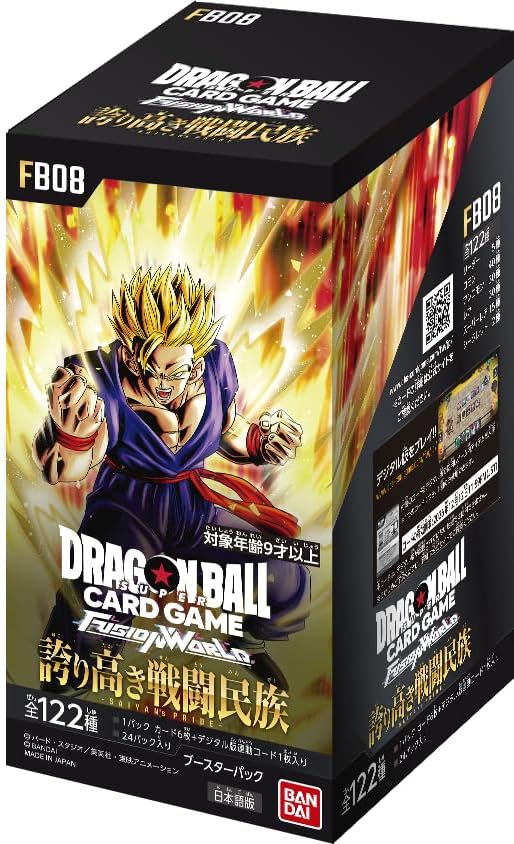
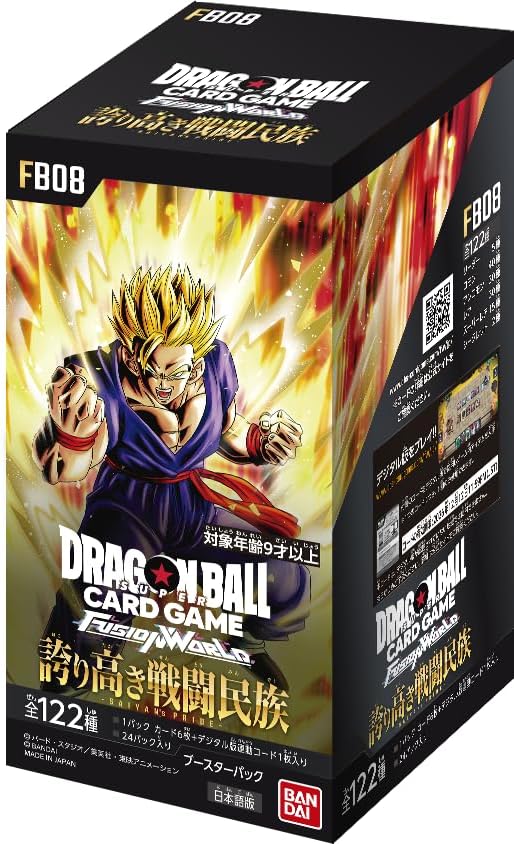
Here’s what BANDAI’s own product pages confirm about rarity distribution in a recent mainline set, Saiyan’s Pride (FB08): 5 Leader types, 40 Common, 30 Uncommon, 30 Rare, 15 Super Rare (SR), and just 2 Secret Rare (SCR) — with Alt-Art versions layered on top of several of those tiers. Notably, BANDAI does not publish official pull-rate percentages for Fusion World packs the way some rival TCGs do. That’s a real downside worth flagging before you crack a box expecting a guaranteed hit rate: you’re buying blind, with no printed odds to check your luck against.
For Competitive Deckbuilders: Starter Decks Are the Efficient Buy
If your goal is a tournament-legal deck, cracking a full booster box to “find” your staples is one of the least efficient ways to get there — you’ll open a lot of filler before landing the specific SR you need, and duplicates you don’t need don’t refund anything. The more efficient competitive path most players actually take is: buy a starter deck as a base (or a Start Deck EX for guaranteed SRs), then buy the two or three specific singles you’re missing from a singles marketplace.
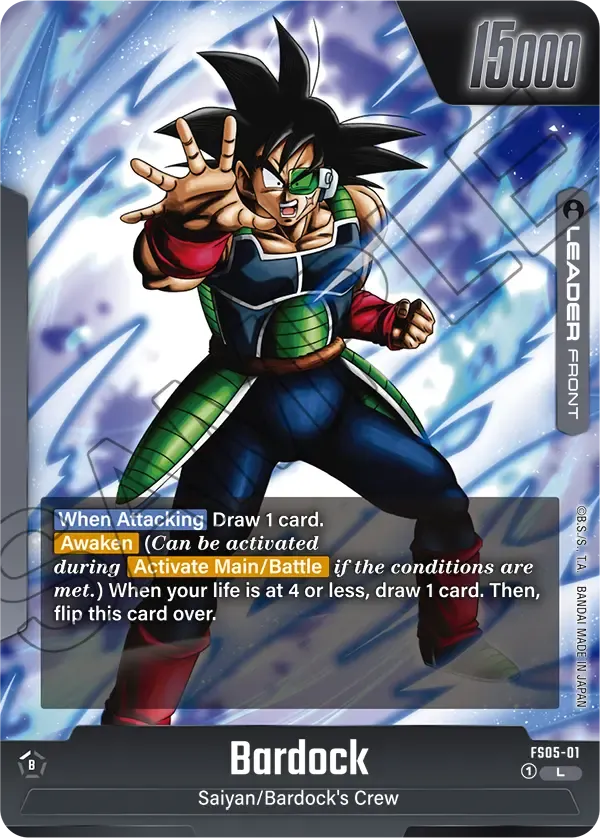
The EX-line starter decks change this math further. Start Deck EX Shallot (FS09) and Start Deck EX Giblet (FS10), both released for the FB09-era environment, each guarantee four Super Rare cards baked into the 51-card list, on top of the Leader — according to BANDAI’s own FS09 product page. That’s meaningfully different from older single-color starters like Start Deck Bardock (FS05), which ship without a guaranteed SR count and lean on solid Rares and Uncommons instead.
The catch: a starter deck’s build is fixed. You can’t chase a different archetype’s staple from inside it, and if the deck’s core strategy doesn’t fit the current meta (tier lists shift with every new FB release), you’re stuck rebuilding around what you were given rather than what you want. A booster box at least gives you a shot — however statistically thin — at any card in the set, including ones from an archetype the starter deck never touches.


For Collectors: Booster Boxes (and Manga Boosters) Are the Only Way In
If the goal is chasing Secret Rares, Special Rares, or alt-art reprints for a binder, starter decks are a non-starter — literally none of the SCR or SPR tier appears in a preconstructed deck’s fixed list. You need randomized packs.
Two product types matter here. Mainline booster boxes (FB02 through FB10 and beyond) are the standard route, and pricing on real, currently-stocked Japanese-print sets tells its own story about how this market behaves. As of this writing (August 12, 2026, JPY/USD around ¥159), a Roar of Rage (FB03) booster box runs roughly $64 landed, while a Saiyan’s Pride (FB08) booster box — the newest set currently in stock at this mall — runs closer to $78. Compare that to the very first set, Awakened Pulse (FB01): TCGplayer listings for sealed FB01 boxes have run $299.99-$329.99 against an original ~$85 MSRP, roughly 3.5x, because BANDAI doesn’t do open-ended reprints of flagship Fusion World sets and FB01 was many players’ entry point into the format. That’s the exception, not the rule — most mid-cycle sets like FB03 through FB08 sit much closer to their original price than FB01 does. Treat any of this as a snapshot, not investment advice; card and sealed-product prices move fast around new releases and bans, and past appreciation on one set doesn’t guarantee the next one repeats it.


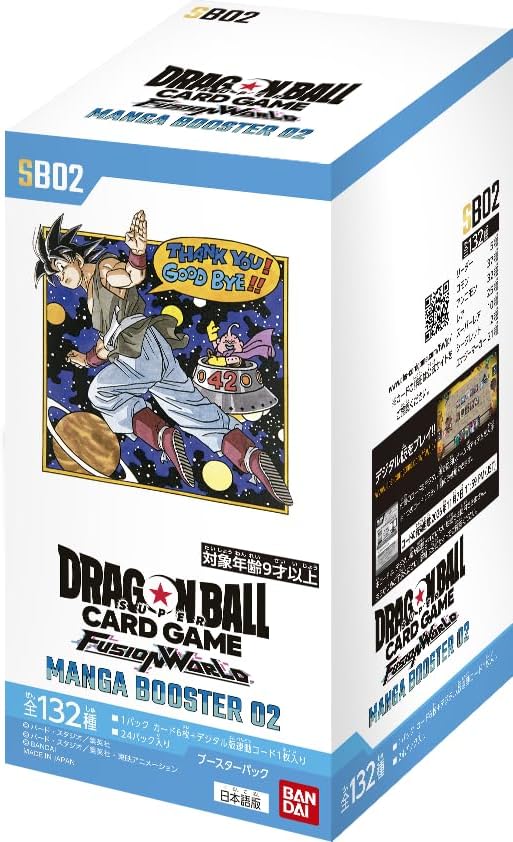
For collectors specifically chasing reprint art rather than new mechanics, there’s also the Manga Booster line (SB01) and Manga Booster 02 (SB02), which reprint classic manga-panel artwork as alternate-art chase cards instead of introducing new competitive cards. They’re priced well above mainline boxes (roughly $232-$318 landed at this mall as of writing) precisely because they’re aimed at display/collection value, not deckbuilding — a real downside if you were hoping to also pull new tournament staples out of the box.

For Casual and Kitchen-Table Players: Two Starter Decks Beat One Box
If you and a friend just want to sit down and play without worrying about the metagame, two different-color starter decks is the highest-fun-per-dollar purchase in the game. You get two complete, balanced, ready-to-play decks the moment you open the box — no deckbuilding, no sorting through 288 cards to figure out what’s playable, and no risk of one player pulling a stacked box while the other opens all filler. A single booster box split between two players, by contrast, means both of you build from a random, uneven pool and one of you will probably end up with a worse deck through no fault of your own.
Buying Real Product: What This Mall Actually Stocks
Discovery Japan Mall ships genuine Japanese-print Fusion World product worldwide, and as of this writing its Dragon Ball category tops out at FB08 (Saiyan’s Pride) for booster boxes and FS11 for starter decks — the newest sets, FB09 “Dual Evolution” and FB10 “Cross Force,” aren’t in its inventory yet. One quirk worth knowing: this mall’s listing titles are literal Japanese-to-English translations rather than BANDAI’s official localized English names, so don’t be thrown off if the title doesn’t match what you’ve seen on English packaging. For example, its listing for FB06 reads “Looming Threat,” while BANDAI’s official English name for FB06 is “Rivals Clash” — same set, same card list, just a different translation of the Japanese title. Likewise FB08 is listed as “Proud Warrior Tribe” rather than its official English name, “Saiyan’s Pride.” As with the mall’s other product lines, everything is genuine Japanese-print, meaning card text is in Japanese even though the game’s Power/Cost/Color icons are universal.
Comparison Table: Real Prices as of August 12, 2026
Prices below are what this mall currently lists (JPY, converted to USD at approximately ¥159/$1), and reflect landed/import pricing rather than raw Japanese MSRP — expect them to run a bit above what a US MSRP box would cost locally, since flagship sets and older stock both carry a premium here.
| Product | Set Code | Contents | Approx. Price (USD) | Best For | Image |
|---|---|---|---|---|---|
| Start Deck Bardock | FS05 | 51-card fixed deck, no guaranteed SR | ~$14 | Cheapest way to learn the game |  |
| Start Deck EX Evolutionary State | FS11 | 51-card fixed deck | ~$24 | Casual play, newer mechanics |  |
| Start Deck EX Giblet | FS10 | 51-card deck, 4 guaranteed SR | ~$35 | Budget-competitive base build |  |
| Start Deck EX Shallot | FS09 | 51-card deck, 4 guaranteed SR | ~$56 | Competitive base build |  |
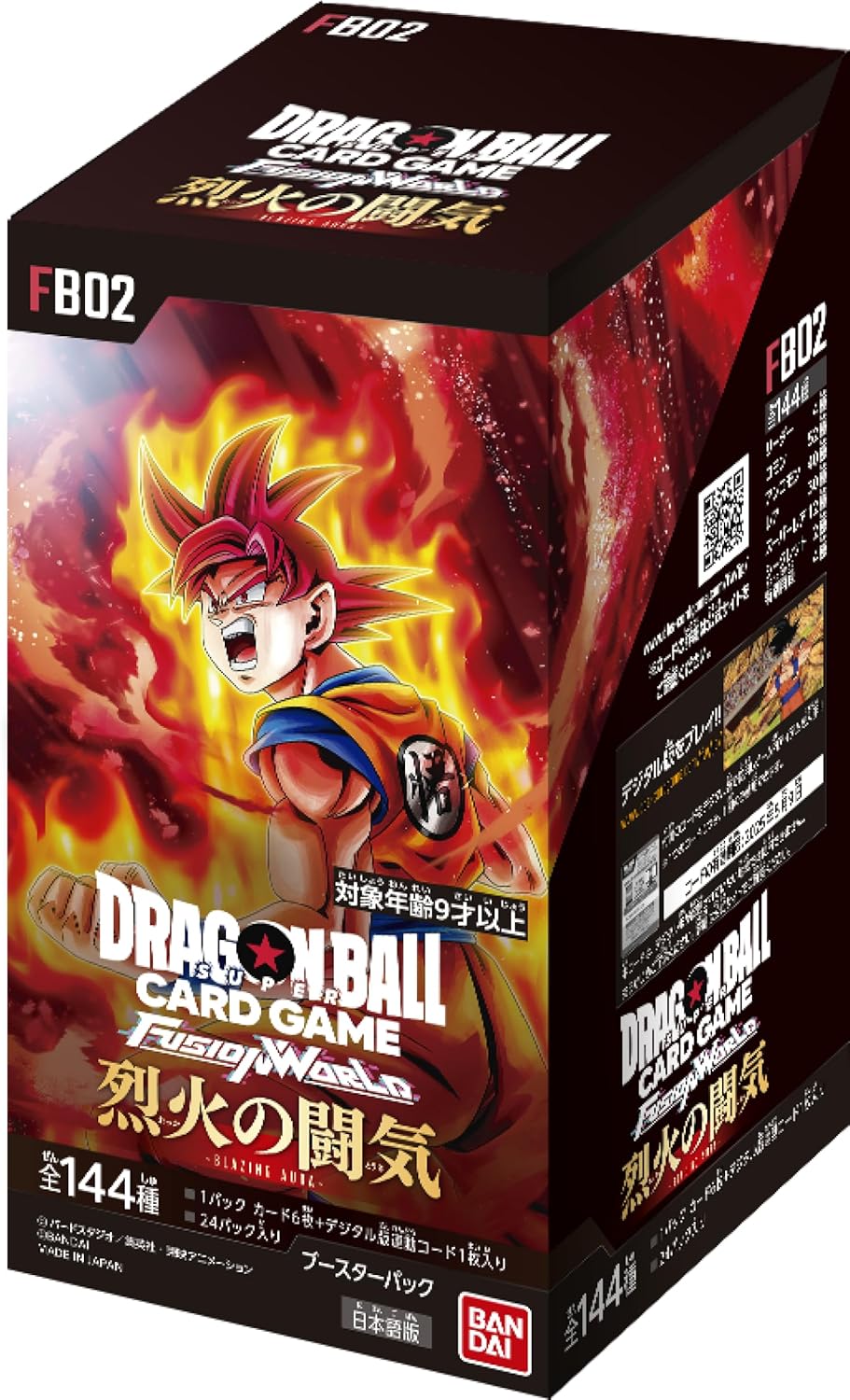
| Booster Box “Blazing Aura” | FB02 | 288 random cards | ~$62 | Cheap bulk/casual box breaks |  |
| Booster Box “Rivals Clash” | FB06 | 288 random cards | ~$62 | Budget collecting |  |
| Booster Box “Raging Roar” | FB03 | 288 random cards | ~$64 | Budget collecting | |
| Booster Box “New Adventure” | FB05 | 288 random cards | ~$76 | Mid-cycle chase cards |  |
| Booster Box “Saiyan’s Pride” | FB08 | 288 random cards | ~$78 | Newest stocked, standard-relevant | |
| Booster Box “Wish for Shenron” | FB07 | 288 random cards | ~$100 | Chase-card collecting | 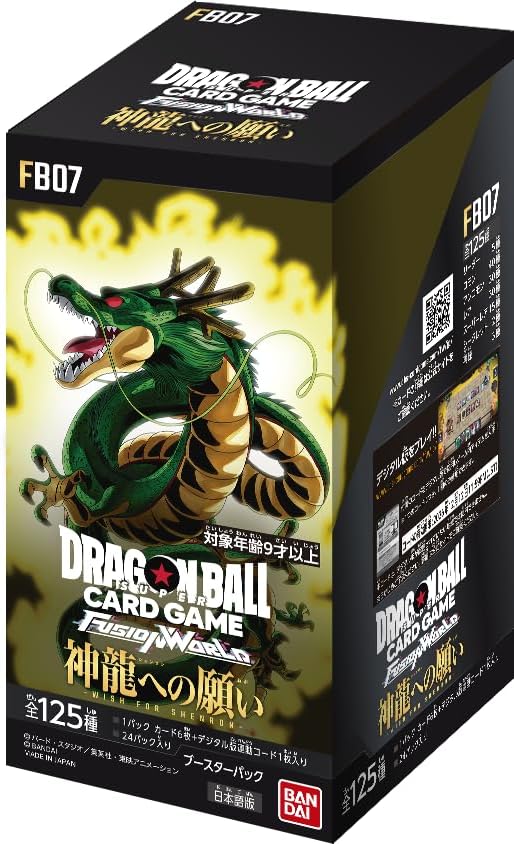 |
| Manga Booster 02 | SB02 | 288 random reprint-art cards | ~$232 | Alt-art display collecting | |
| Manga Booster 01 | SB01 | 288 random reprint-art cards | ~$318 | Alt-art display collecting | |

If you’re totally new to Fusion World and want the fundamentals — how turns work, which color fits your playstyle, and a wider look at where the current meta stands — our Fusion World beginner’s guide covers that ground in more depth than this article does.
Frequently Asked Questions
Is a booster box ever a bad buy for a new player?
Usually, yes, if the goal is learning to play. A box gives you a huge pile of loose cards with no coherent strategy and no rulebook context, which means more time sorting and less time actually playing. A starter deck is the more efficient on-ramp; save the box for after you know what you want to build.
Do Start Deck EX products actually contain good Super Rares, or just filler?
BANDAI’s own product pages for FS09 and FS10 confirm four guaranteed Super Rare cards per deck, on top of the Leader. Whether those specific SRs are meta staples in the current FB10-and-beyond environment varies set to set, so don’t assume every EX starter’s SRs are still tournament-relevant by the time you buy — check a current tier list first.
Why do some older booster boxes cost more than newer ones?
It’s almost entirely about print runs and chase-card demand. BANDAI doesn’t do open-ended reprints of flagship Fusion World sets, so a set with strong chase cards and no reprint (like launch set FB01) can hold or gain value, while a set with weaker chase cards or that’s simply less scarce can sit near or even below its original price. This is not a reliable investment strategy — treat any price appreciation as a bonus, not the reason to buy.
Can I mix and match — buy a starter deck now and upgrade with box pulls later?
Yes, and this is genuinely one of the more common approaches among Fusion World players. Start with a starter deck to learn one color, then either crack a box from the same or a compatible-color set to look for upgrades, or buy singles directly for the specific cards you’re missing. Just confirm color compatibility with your Leader before buying — every non-Leader card in your deck needs to share at least one color with it.
Is Japanese-print product from an import mall safe to buy, and will it work for English tournaments?
Sealed booster boxes and starter decks from an established retailer carry much lower counterfeit risk than loose singles bought from unverified marketplace sellers, since sealed product is harder to fake convincingly at scale. That said, Japanese-print card text won’t be in English, and tournament organizers set their own policies on language — check with your specific event or store before entering Japanese-print cards into an English-language sanctioned tournament.
Takeaway
There’s no universal “better” purchase here — a starter deck (especially an EX one) is the more efficient buy if you want a playable, competitively-relevant deck without gambling on pack luck, a booster box or Manga Booster is the only route to Secret Rares and alt-art chase cards, and two starter decks is the best deal in the game if you just want a fair, fun match with a friend tonight. Figure out which of those three goals you actually have before you check out, since the “best value” product changes completely depending on the answer.
Related Articles
- Dragon Ball Fusion World Card Value Myths, Debunked
- How to Build a Competitive Fusion World Deck (2026)
More Trading Card Game Guides
- One Piece Card Game: Booster Box vs. Starter Deck Value (One Piece Card Game)
- Booster Box vs. Singles: Which Wins in Pokémon TCG? (Pokémon TCG)
Comments