※本ページはプロモーションが含まれます
Disclosure: This post contains affiliate links. If you buy through them, we may earn a commission at no additional cost to you. Learn more.
If you’re picking up Dragon Ball Super Card Game Fusion World for the first time in 2026, here’s the short version: grab a single-color starter deck to learn the rules for about $15-20 equivalent, then expand into booster packs once you know which color (Red, Blue, Green, Yellow, or Black) fits your playstyle. The game itself is simple — eight Life points, one Leader, one Energy per turn — but knowing which of the now ten-plus booster sets to actually buy is where new players get stuck. This guide covers both.
Fusion World is BANDAI’s ground-up relaunch of the Dragon Ball card game, first released in Japan in February 2024 and internationally later that year. It is a completely separate product line from the older Dragon Ball Super Card Game (that game didn’t die — it was rebranded “Masters” and keeps running its own Zenkai Series in parallel). None of your old DBS cards are playable in Fusion World, and that’s actually good news for beginners: everyone started from card #1 at the same time, so there’s no twelve-set backlog to catch up on to be “meta relevant.”
- What Makes Fusion World Different From the Old DBS Card Game
- How to Play: The Basics in Five Minutes
- Building Your First Deck: Pick a Color, Not a Character
- Starter Deck or Booster Box? How to Buy In
- The Set Timeline: FB01 Through FB12
- Where the Meta Stands as of August 2026
- Fusion World vs. Pokemon and One Piece: A Quick Gut Check
- Frequently Asked Questions
- Takeaway
- Related Articles
- More Trading Card Game Guides
What Makes Fusion World Different From the Old DBS Card Game
The original Dragon Ball Super Card Game (2015-2023) had a reputation for being math-heavy and slow, with combat that involved a lot of layered triggers. Fusion World was built to fix that. According to BANDAI’s own announcement of the relaunch, the new system emphasizes faster turns and simpler combat resolution while keeping the character roster just as deep.
The two systems are not compatible — you cannot mix Masters-era cards into a Fusion World deck, and vice versa. If you see a listing for “Dragon Ball Super Card Game” cards online, check carefully whether it’s Fusion World (card numbers start with FB, FS, or SB) or Masters (numbers start with DBS-B or similar) before buying, since the two are easy to confuse and aren’t interchangeable at your local game store.
How to Play: The Basics in Five Minutes
Every Fusion World match uses the same core structure:
- Leader Card: One card representing your character on the field the whole game. It has a Power stat, a Skill, and a Color. Every other card in your deck must share at least one color with your Leader.
- Life Area: At setup, you place the top 8 cards of your deck face-down as your Life. You lose when your last Life card is removed (or when your deck runs out of cards to draw from).
- Energy Area: You charge exactly one card from your hand into Energy per turn. Energy is colorless — any card can be charged — and you pay costs by resting Energy cards equal to a card’s printed cost.
- Battle Area: Battle Cards you play here can attack the same turn they’re summoned, which is a big departure from a lot of other anime TCGs and keeps games fast.
A turn goes: stand up your rested cards, draw one, charge one card to Energy, then play cards and attack. Decks are 50-60 cards (Battle + Extra cards) plus your one Leader, with a 4-copy limit per card. If you want the exact wording, BANDAI publishes the full rule book as a free PDF on the official Fusion World site — worth a skim once you’ve played a few games casually.
Building Your First Deck: Pick a Color, Not a Character
New players often want to build around a favorite character first. Better approach: pick a color first, because color defines your general strategy far more than any single card does.
- Red decks tend to reward straightforward, easy-to-read effects — good for players who want to understand what their cards do without a rules glossary.
- Blue decks often play a hand-control game, keeping card count low to unlock powerful activation conditions.
- Green decks lean on Energy manipulation for big bursts of Power.
- Yellow decks are more about board control and removal.
- Black was added later in the set list and generally plays a disruptive, resource-denial game.
The downside of Fusion World’s simplicity: because combat math is lighter than the old game, a lot of games come down to who curves out their Power numbers better, which can feel repetitive if you’re used to combo-heavy TCGs like Yu-Gi-Oh. It rewards deckbuilding and sequencing more than intricate stack interactions — know that going in.
Starter Deck or Booster Box? How to Buy In
For a true beginner, a starter deck beats a booster box almost every time. A preconstructed deck is playable out of the box, teaches you a coherent single-color strategy, and costs a fraction of a booster box. Booster boxes are a better move once you already know what you want to build around and are chasing specific Super Rare (SR) or Secret Rare (SEC) chase cards.
Since this mall ships real Japanese-print Fusion World product worldwide, here’s what’s actually in stock there right now (as of August 2026) that’s relevant to a new player:
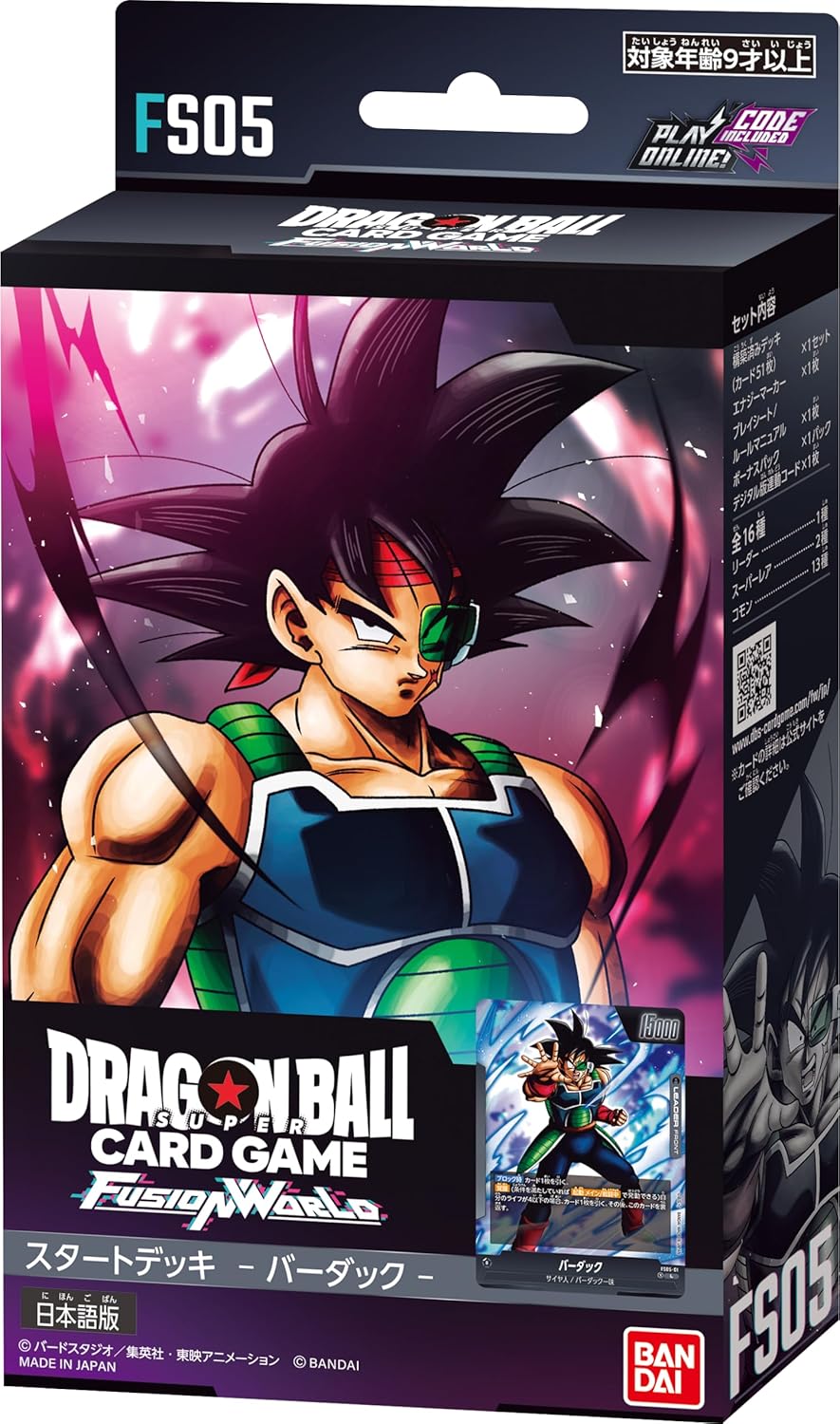
- Start Deck Bardock (FS05) — the cheapest way to get a full 51-card preconstructed deck plus energy markers and a rule sheet in hand. Great for learning the fundamentals with a real Leader instead of proxies.

- Start Deck EX Shallot (FS09) and Start Deck EX Giblet (FS10) — newer “EX” starter decks that each pack four Super Rare cards alongside the Leader, so they hit harder out of the box than the original launch decks, at a slightly higher price.


- Start Deck EX Evolutionary State (FS11) — the most recent EX deck this mall stocks, built around the newer Fusion Evolve mechanic introduced with FB09.

- Booster Pack Roar of Rage (FB03) Booster Box — an older, budget-friendly box (24 packs) if you just want to crack packs and build a bulk collection cheaply. Be aware most FB03-era chase cards are no longer meta-relevant, so treat this as a fun/collecting purchase, not a competitive investment.

- Booster Pack Saiyan’s Pride (FB08) Booster Box — listed on this mall under its literal Japanese-to-English title “Proud Warrior Tribe,” this is the same all-Saiyan-Leader set BANDAI released in English as “Saiyan’s Pride” in December 2025. It’s a much better bet than FB03 if you want cards that still see standard-format play.

Important caveat: everything above is genuine Japanese-print product shipped from Japan — the card text will be in Japanese, not English. Fusion World’s icons for Power, Cost, and Color are numeric/color-coded and easy to read regardless of language, but Skill text (the actual card abilities) is not. If you want to read every card in English, look for boxes explicitly labeled English-print at your local game store or a US-based retailer instead; if you’re comfortable cross-referencing an English card database (BANDAI’s own card search tool works for this) or you mainly want the cards for collecting/display, Japanese print is a legitimate and often cheaper way in.
Also worth knowing: this mall’s current Fusion World stock tops out at FB08 (Saiyan’s Pride) — the two newest sets, FB09 “Dual Evolution” (March 2026) and FB10 “Cross Force” (June 2026), aren’t showing in inventory as of this writing. If you specifically want the newest cards, check a US singles retailer or TCGplayer for those two sets.
The Set Timeline: FB01 Through FB12
| Set Code | Official Name | Release (approx.) |
|---|---|---|
| FB01 | Awakened Pulse | Feb 2024 (JP) |
| FB02 | Blazing Aura | May 2024 |
| FB03 | Raging Roar | Aug 2024 |
| FB04 | Ultra Limit | Nov 2024 |
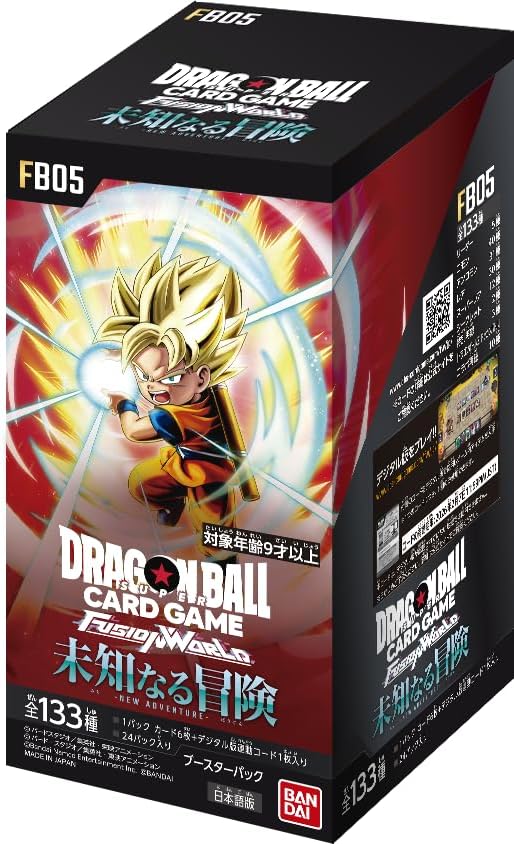
| FB05 | New Adventure | Jan 2025 |
| FB06 | Rivals Clash | May 2025 |
| FB07 | Wish for Shenron | Sept 2025 |
| FB08 | Saiyan’s Pride | Dec 2025 |
| FB09 | Dual Evolution | Mar 2026 |
| FB10 | Cross Force | Jun 2026 |
| FB11 | Brightness of Hope | Oct 2026 (announced) |
| FB12 | Reach the God | Winter 2026 (announced) |
There are also two “Manga Booster” sets (SB01 and SB02) that reprint classic manga panels as alternate art instead of following the mainline numbering — fun for collectors, but they skew toward reprints rather than new mechanics, so don’t expect a huge power jump from them.
Where the Meta Stands as of August 2026
As of this writing, FB10 “Cross Force” is the newest legal set, and it leaned into two mechanics: “Evolve” and “Ki” (an energy marker placed under a card). Community tier lists compiled after FB09’s release have pointed to Majin Buu variants, Android-synergy Red/Cell decks, and Kid Buu control lists as consistently strong performers going into the FB10 environment — but tier lists shift fast with every new set, so treat any specific deck ranking as a snapshot, not gospel. Fusion World doesn’t currently run a rotating Standard format the way some rival TCGs do (every legal set from FB01 onward is still tournament-legal), but BANDAI does actively maintain a banned/restricted list that gets updated a few times a year, most recently with changes effective around July 2026. Always check the official banned/restricted list before building a tournament deck — a card that was a format staple two sets ago can be sitting on that list today.
None of this is financial advice — card prices for chase SR/SEC cards move a lot around new set releases and bannings, and what’s hot in August 2026 may cool off by the next set. Treat singles as something you buy to play with first, invest in a distant second.
Fusion World vs. Pokemon and One Piece: A Quick Gut Check
If you’re coming from Pokemon TCG or One Piece Card Game and wondering whether Fusion World is worth the switch: Fusion World’s combat resolves faster (Battle Cards can attack the turn they’re played, and there’s no complex block/counter stack to track), and its Life-as-resource system means every attack matters immediately rather than building toward one big finisher. The tradeoff is a shallower combo ceiling — competitive Fusion World rewards curve and sequencing more than intricate card-interaction chains, which some veteran TCG players find less satisfying long-term. If you like games where board position and tempo matter more than stack tricks, it’s an easy recommendation; if you live for combo lines, it may feel thinner after a few months.
Frequently Asked Questions
Is Dragon Ball Super Card Game Fusion World the same as the old Dragon Ball Super Card Game?
No. Fusion World is a separate, from-scratch relaunch that started in February 2024. The original game continues under the name “Dragon Ball Super Card Game Masters” with its own Zenkai Series sets, and the two card pools are not compatible with each other.
What’s the cheapest way for a total beginner to start playing?
A single starter deck. It comes pre-built and playable, teaches one color’s strategy cleanly, and typically costs a fraction of a booster box. Add a second starter deck (a different color) for your first opponent, and you have everything needed for kitchen-table games.
Does Fusion World have card rotation like some other TCGs?
Not a rotating Standard format — every mainline booster from FB01 onward remains tournament-legal as of August 2026. BANDAI does maintain an active banned/restricted list that’s updated periodically, so always check the current list before entering an event.
Can I use Japanese-print Fusion World cards in English-language tournaments?
Policies vary by event and region, so check with your local tournament organizer first. For casual play, mixed-language tables are extremely common in this game since the icons for Power, Cost, and Color are universal, but ability text will only be readable in whichever language the card was printed in.
Where can I buy real Fusion World product safely?
Stick to established retailers, official BANDAI channels, or reputable import shops rather than unverified marketplace listings, especially for loose singles — counterfeit cards are a real risk with high-value chase cards bought from unknown sellers. Sealed booster boxes and starter decks from known retailers carry much less risk than loose singles of a chase SR or Secret Rare.
Takeaway
Fusion World in August 2026 is a mature-enough game (ten mainline sets deep, an eleventh on the way in October) that a new player doesn’t need to worry about being hopelessly behind — the game just launched from zero in 2024, so nobody has a decade of legacy cards to out-collect you with. Start with a single-color starter deck, learn the eight-Life, one-Energy-per-turn rhythm, then decide whether you’re chasing the current FB10 “Cross Force” meta or just building a fun casual box from an older, cheaper set. Either way, know whether you’re buying Japanese or English print before you check out, since that’s the detail that trips up the most first-time buyers.
Related Articles
- Dragon Ball Super Card Game: Original vs. Fusion World
- How to Buy Dragon Ball Fusion World Cards Safely (2026)
- Best Dragon Ball Fusion World Leader Cards, Ranked (Aug 2026)
More Trading Card Game Guides
- One Piece Card Game vs. Pokemon vs. Dragon Ball TCG (2026) (One Piece Card Game)
- Pokémon TCG Beginner’s Guide 2026: What to Buy First (Pokémon TCG)
Comments