※本ページはプロモーションが含まれます
Disclosure: This post contains affiliate links. If you buy through them, we may earn a commission at no additional cost to you. Learn more.
[Evolve] lets you play a Battle Card from your hand directly on top of a specific Battle Card you already control, paying a small skill cost instead of the card’s printed cost. It is the cheapest way in Dragon Ball Fusion World to put a huge body on the board — and the fastest way to lose two cards to one removal spell, because everything under the top card goes straight to the Drop Area when the stack is destroyed.
That second half is the part nobody explains at the game store, and it’s the difference between Evolve decks that win and Evolve decks that get blown out. Here’s the full mechanic, straight from BANDAI’s own rules FAQ, plus how to build around the risk.
- What [Evolve] Actually Does
- What Carries Over, and What Doesn’t
- The Risk Nobody Mentions: Stack Loss
- [Fusion Evolve]: The Same Trade, Doubled
- Where Evolve Came From, and Where It’s Going
- Building an Evolve Deck Without Getting Blown Out
- Frequently Asked Questions
- Takeaway
- Related Articles
- More Trading Card Game Guides
What [Evolve] Actually Does
BANDAI’s official FAQ (entry Q400) defines it in one line: “Cards with [Evolve] can be played from your hand on top of a specified Battle Card.”
The procedure (Q401) is:
- At the same timing as an [Activate Main] skill, reveal the [Evolve] card from your hand.
- Select 1 Battle Card in your Battle Area that meets the [Evolve] card’s stated conditions.
- Pay the skill cost printed on the [Evolve] skill.
- Play the card on top of the selected card, without paying its normal cost.
The card underneath stays on the field, physically under the new card. It is still there — it just isn’t doing anything.
Two clarifications that come up constantly:
- Evolve cards are not Evolve-only. Q402 confirms they function as ordinary Battle Cards and can be hard-cast for their printed cost if you don’t have a valid target. A 5-cost Evolve card with no base on board is just a 5-cost card.
- Evolve is not a free extra play. You’re paying a cost, it just tends to be far less than the card’s printed cost.

What Carries Over, and What Doesn’t
This is where new Evolve players make real mistakes. The rules are narrow and specific.
| Property of the base card | Carried onto the Evolve card? | Source |
|---|---|---|
| Active Mode / Rest Mode | Yes — Evolve inherits the base’s mode exactly | Q403 |
| Temporary power modifiers | Yes, and they revert at end of turn as normal | Q404 |
| Anything else (restrictions, granted skills, counters) | No | Q405 |
| Skills of the card now underneath | No — they’re deactivated | Q457 |
The mode inheritance is the one that decides games. If your base card is in Rest Mode — because it already attacked, or because you charged it — your Evolve card enters play in Rest Mode too (Q403). It cannot attack. Evolving onto a card that already swung this turn does not buy you a second attack; it buys you a bigger blocker for next turn.
Conversely, evolving onto an Active Mode card gives you an Active Mode threat immediately, which is the play everyone is actually trying to make.
The “restrictions don’t carry over” line (Q405) cuts in your favor. If your base card was hit with an effect that stopped it attacking, the Evolve card played on top is not bound by that restriction. That’s a legitimate, underused way to answer attack-lock effects.
The Risk Nobody Mentions: Stack Loss
Here’s the rule that makes Evolve a genuine gamble, quoted from Q406:
When a card is moved from the Battle Area to another area, only the top card is moved to the specified area; all cards underneath it will be placed in the Drop Area.
Read that carefully. If your opponent KOs your evolved card, the top card goes wherever the effect sends it, and every card in the stack beneath it goes to the Drop Area regardless. One removal effect eats two of your cards. If you evolved twice onto the same body, it eats three.
This has three practical consequences:
- Cheap removal is the natural predator of Evolve decks. Any effect that KOs a Battle Card gets a 2-for-1 against you, and low-cost removal gets a 2-for-1 at a profit.
- Bounce and recursion effects don’t save the stack. Even an effect that returns the card to your hand only returns the top card. The base is gone.
- Evolving into an empty opposing board is usually correct; evolving into a board with open energy is usually not. If your opponent has the energy for their color’s removal, you’re handing them value.
The honest strategic summary: Evolve trades card economy for tempo. You get a large body earlier than the cost curve should allow, and you pay for it by making your board fragile in a way normal plays are not.
[Fusion Evolve]: The Same Trade, Doubled
FB09 Dual Evolution (March 2026) introduced [Fusion Evolve], which is Evolve’s mechanic extended to two base cards — thematically, two characters merging rather than one powering up.
The procedure (Q530) mirrors Evolve but requires exactly 2 Battle Cards meeting the conditions. You stack them in any order and play the Fusion Evolve card on top of both.
Three differences matter:
- It always enters in Active Mode (Q531), regardless of the modes of the two cards underneath. This is a significant upgrade over Evolve — you can fuse two rested bodies into an active threat.
- Power modifiers carry over (Q533), but non-power effects like attack restrictions do not (Q534).
- Stack loss is worse. Q535 restates the same rule: only the top card moves, everything underneath hits the Drop Area. One removal spell on a Fusion Evolve stack costs you three cards.
FB09’s flagship example is Gogeta. The set gave Gogeta: BR (FB09-001) and Gogeta: GT (FB09-097) as Leaders, and the Fusion Evolve payoff cards fuse the corresponding Son Goku and Vegeta bodies — one widely-discussed line plays a fused body on top of Son Goku: BR and Vegeta: BR and switches it to Active Mode for a skill cost of 1.


The deckbuilding cost is real and it’s steep. To use Fusion Evolve you must have two specific, named cards on the field simultaneously. That’s a three-card combo (two materials plus the payoff) held together with no protection, against a format where removal exists in every color. FB09 boxes are also no longer carried by the export mall we use, so building this from sealed product means the secondary market at secondary-market prices.
Where Evolve Came From, and Where It’s Going
| Set | Released | What it added |
|---|---|---|
| FB07 Wish for Shenron | Sept 13 (JP) / Sept 19 (EN), 2025 | [Evolve] debuts, on Red SRs Son Goku: DA (FB07-010) and Vegeta: DA (FB07-021) |
| FB09 Dual Evolution | March 2026 | [Fusion Evolve] and [Ki] arrive on Leaders; Gogeta package |
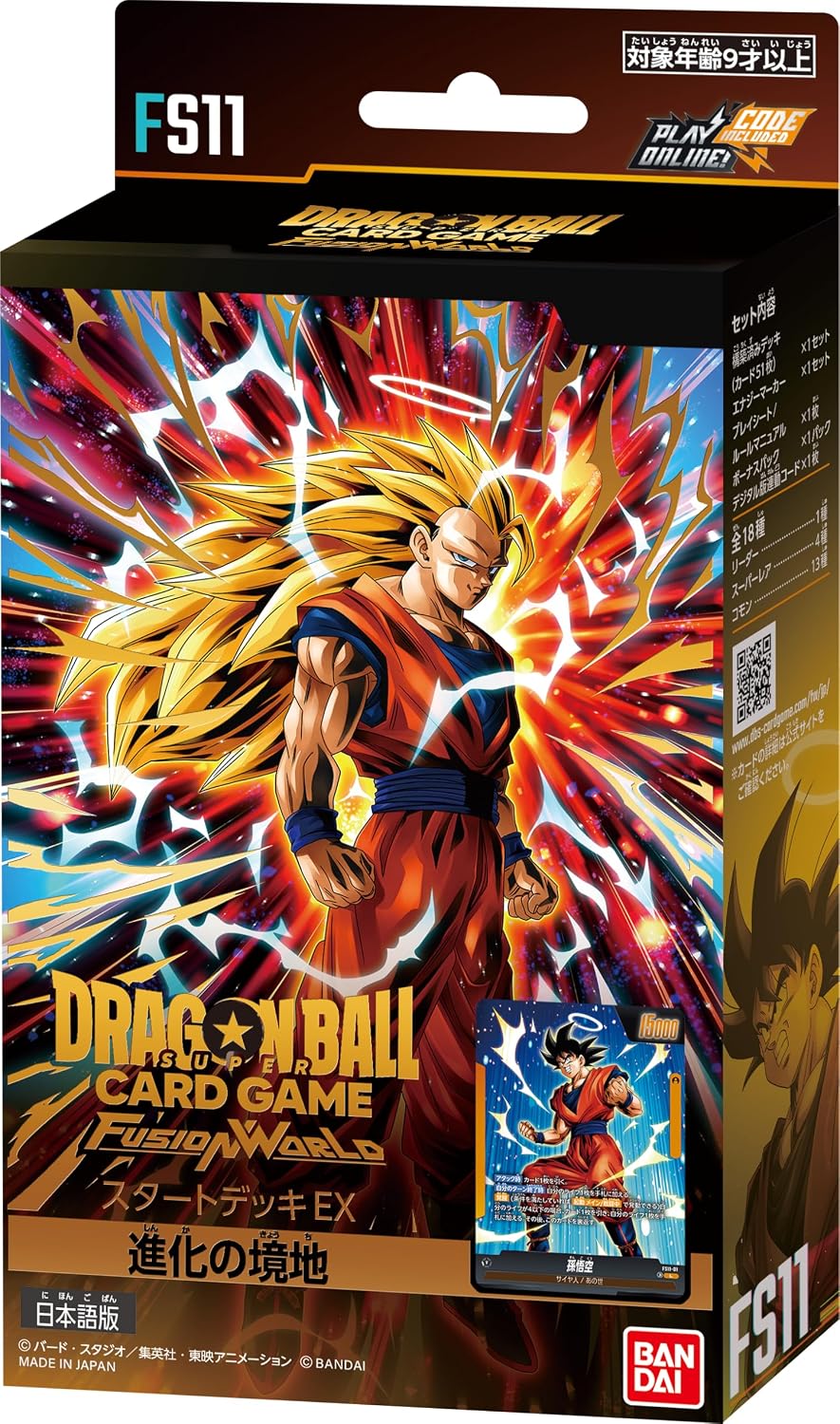
| FS11 The Phase of Evolution | March 2026 | A full preconstructed Evolve deck with a Leader built to reward it |
| FB11 Brightness of Hope | Sept 12 (JP) / Oct 16 (EN), 2026 | More Red Evolve support, including a cost-reduction enabler |
FS11 is the cleanest expression of the archetype. Its Leader, FS11-01 Son Goku, has [When Attacking] Draw 1 card and [End of Your Turn] Add 1 card from your life to your hand — and after awakening, when you have 3 or more energy in Rest Mode and you play a card with 20,000 to 30,000 power that has [Evolve], you switch 2 of your energy to Active Mode.

That awakened skill is the whole design thesis: Evolve normally costs you tempo in energy, and this Leader refunds it, letting you deploy a 20–30k body and still have energy open. It’s also a narrow trigger — the power band is specified, so a 15,000-power Evolve card gets you nothing.
FB11 continues the thread on the Red side. Great Saiyaman, one of the set’s Red SRs, reduces the cost of the next [Evolve] skill you activate from your hand by 2, and has an On Play skill that plays up to 1 cost-1 Battle Card. Trunks: Youth in the same color also carries Evolve-related text. We break the rest of the set down in our FB11 Brightness of Hope review.
Is an Evolve deck actually competitive right now?
Honestly: it’s a real archetype, not a top-of-format one, and anyone claiming certainty about FB11-era Evolve as of September 29, 2026 is ahead of the data. FB11 has been legal in Japan for under three weeks and isn’t out in English yet. What we can say is that the archetype has received support in three of the last five sets, which is a strong signal about BANDAI’s intentions.
For a grounded read on what’s actually winning, see our Fusion World Leader tier list — it covers the environment through FB10 with tournament results behind it.
Building an Evolve Deck Without Getting Blown Out
Four rules that follow directly from the mechanics above:
- Keep your Evolve targets cheap. If the base card cost you 1–2 energy, a 2-for-1 against you is survivable. If it cost you 4, it isn’t.
- Evolve on your turn, into an attack. The value of Evolve is tempo, and tempo you don’t convert is tempo your opponent gets to answer. Evolving onto an Active Mode card and swinging immediately is the play the mechanic is designed for.
- Don’t over-stack. Two layers is a 2-for-1 risk; three layers is a 3-for-1 risk. There’s rarely enough upside to justify the third card.
- Count your opponent’s open energy before you commit. This is the single highest-value habit in the archetype.
Where to Buy the Pieces
BANDAI Dragon Ball Super Card Game Fusion World Start Deck EX Evolutionary State (FS11) — ¥3,855, about $25 at ¥157 to the dollar. BANDAI’s English name for this product is Starter Deck EX: The Phase of Evolution; the export listing uses a literal translation of the Japanese title. It’s a 51-card ready-to-play deck built entirely around Evolve, with four SR types (double a standard starter), an energy marker set, a rule manual, a bonus pack, and a digital-version promo code.

Downside: every card in an EX deck is foil. That’s great for display and mildly annoying for play — foils warp, and a warped card in a sleeved deck is a card your opponent can identify from the back. Plan on double-sleeving if you take this to events.
BANDAI Dragon Ball Super Card Game Fusion World Booster Pack: Wishes For Shenron (FB07) (Box) 24 Packs — ¥15,872, about $101. Officially Wish for Shenron. This is the set where Evolve debuted, so it’s where the original Son Goku: DA and Vegeta: DA printings live, alongside the DAIMA Mini cards and the GT Shadow Dragons.
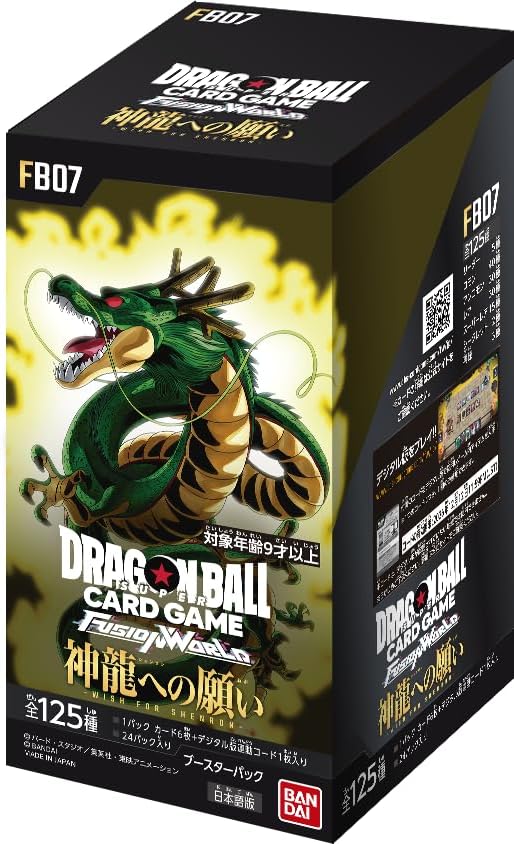
Downside: this is the most expensive box on this page and the set is now four releases old. If you want two specific Red SRs, buying them as singles will cost a fraction of $101 — a box only makes sense if you want the whole set’s card pool.
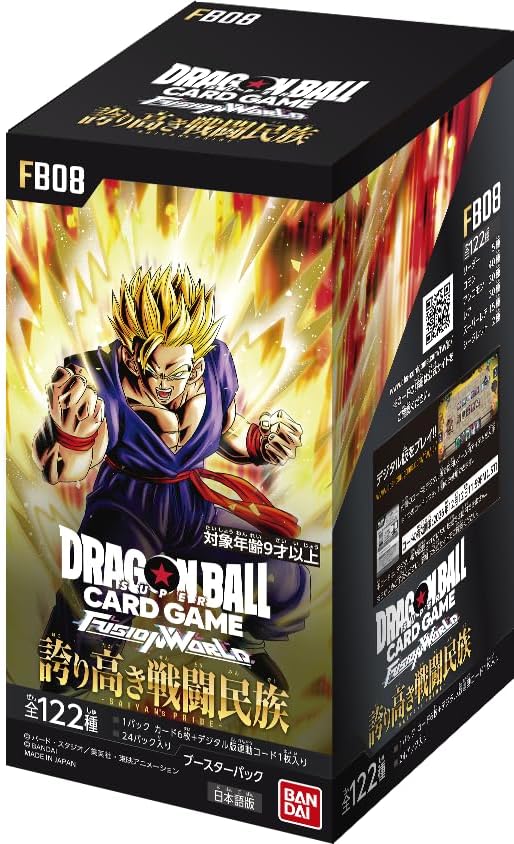
BANDAI Dragon Ball Super Card Game Fusion World Booster Pack Proud Warrior Tribe (FB08) (Box) 24 Packs — ¥12,375, about $79. FB08, published in English as Saiyan’s Pride. Sits directly between the two Evolve sets and is the newest main set still available at close to sane pricing.

Downside: FB08 doesn’t add Evolve cards. It’s a good general-purpose box for filling out a Red or Black deck, not an archetype purchase.
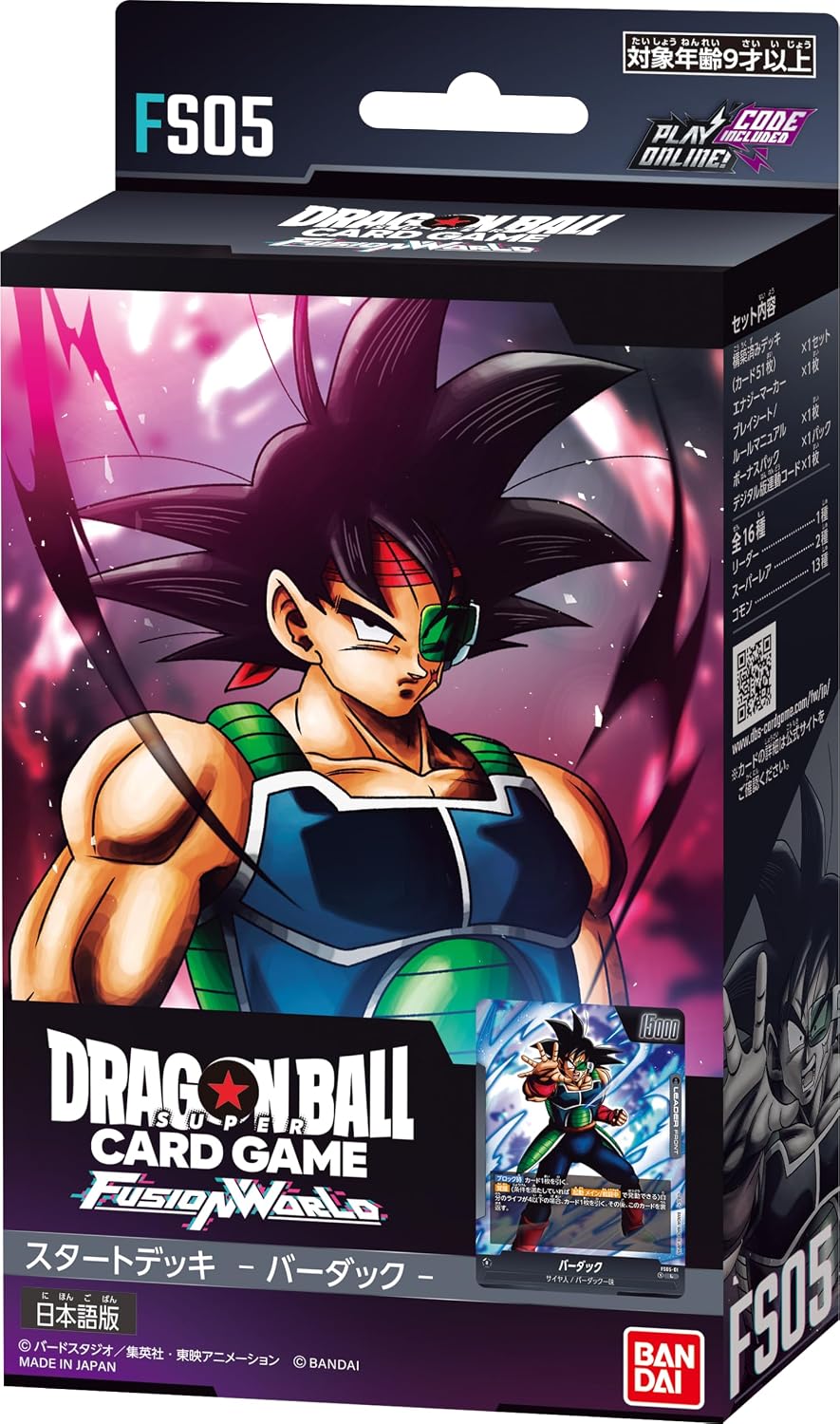
BANDAI Dragon Ball Super Card Game Fusion World Start Deck Bardock (FS05) — ¥2,177, about $14. Not an Evolve deck, but at $14 it’s the cheapest legal 51-card deck on the market and the sensible thing to hand a friend so you have someone to test the archetype against.

Downside: FS05 is an early, non-EX starter with a card pool that’s been outclassed for a year. It’s a teaching deck, not a competitive shell.
Frequently Asked Questions
Can I play an [Evolve] card normally if I have no base card?
Yes. Official FAQ Q402 confirms [Evolve] cards work as ordinary Battle Cards and can be played by paying their standard cost. The Evolve skill is an alternative, cheaper route, not a restriction.
What happens to the card underneath when I use [Evolve]?
It stays on the field under the new card, but its skills are deactivated (Q457). If the stack ever leaves the Battle Area, only the top card goes to the destination and every card underneath goes to the Drop Area (Q406) — which is why one removal effect can cost you two cards.
Does an Evolve card enter play able to attack?
Only if the base card was in Active Mode. Q403 states the Evolve card inherits the base’s mode exactly: Rest Mode base means Rest Mode Evolve card. [Fusion Evolve] is the exception — Q531 confirms it always enters in Active Mode regardless of its materials’ modes.
What’s the difference between [Evolve] and [Fusion Evolve]?
[Evolve] stacks onto 1 specified Battle Card and inherits its mode. [Fusion Evolve], introduced in FB09 Dual Evolution, stacks onto exactly 2 specified Battle Cards, is always played in Active Mode, and costs you three cards rather than two if the stack is removed.
Are Evolve cards legal for tournament play right now?
Yes. As of September 29, 2026 no Evolve or Fusion Evolve card appears on the Fusion World banned or restricted list, which is unchanged from its March 13, 2026 revision at three banned and five restricted cards. Fusion World also has no rotation, so FB07 cards remain legal — the current banlist breakdown has the full list.
Takeaway
Evolve is one of the best-designed mechanics in Fusion World precisely because its upside and its downside come from the same rule. You put a body on the table that you shouldn’t be able to afford yet, and in exchange your board becomes worth more than one card to remove.
Play it knowing that. Keep your bases cheap, evolve into an attack rather than into an empty turn, count your opponent’s open energy before you commit, and resist the temptation to build three-high stacks because they look impressive. FS11 is the cheapest honest way to learn the archetype, and at roughly $25 it costs less than the singles you’d need to approximate it.
Product prices stated as of September 29, 2026, at an approximate rate of ¥157 to US$1. Rules citations are from BANDAI’s official Fusion World FAQ. Card values fluctuate and the competitive environment shifts frequently; nothing in this article is financial advice.
Related Articles
- Dragon Ball Fusion World Pull Rates Explained (2026)
- Dragon Ball Fusion World Colors Explained: Which to Pick
- Dragon Ball Fusion World vs Pokémon vs One Piece TCG: The Real Comparison
More Trading Card Game Guides
- One Piece Card Game Rules: How a Turn Actually Works (One Piece Card Game)
- NARUTO CARD GAME Mechanics Explained: The July 29 Reveal (Naruto Card Game)
- Pokémon TCG Pull Rates Explained: Odds vs. Reality (Pokémon TCG)
Comments