※本ページはプロモーションが含まれます
Disclosure: This post contains affiliate links. If you buy through them, we may earn a commission at no additional cost to you. Learn more.
Short answer: a Japanese-print and English-print Dragon Ball Super Card Game Fusion World card are the exact same card — same stats, same art, same rules text once translated — but Japan almost always gets each set first, Japanese boxes are usually cheaper before shipping, and the card text itself is only readable in whichever language it was printed in. Whether you can actually play a Japanese-print card at your local English-language tournament depends on your region and your TO, which is the part most new importers get wrong. Here’s what’s actually different, and where to buy real Japanese product if you decide it’s worth it.
What’s Actually the Same
Before getting into differences, it’s worth being clear about what doesn’t change. Fusion World cards are standard TCG size (2.6″ x 3.6″ / roughly 63mm x 88mm) in both languages, so Japanese-print cards fit the same penny sleeves, toploaders, and deck boxes you’d use for Pokémon or One Piece cards — no special “Japanese small size” sleeve needed like you’d worry about with, say, older Yu-Gi-Oh product. Card stock is BANDAI’s standard Japanese-manufactured stock for both print runs (thinner and slightly more flexible than Pokémon’s stock, similar to One Piece), rarities (C, UC, R, SR, SCR, L) work identically, and the power/cost/color icons are numeric and color-coded rather than text-based, so they read the same regardless of language. If you’re buying purely to collect sealed product or build a binder, the physical experience is nearly identical either way.
Four Real Differences That Actually Matter
1. Japan gets new sets first — sometimes by months, sometimes by days. FB01 “Awakened Pulse” released in Japan on February 16, 2024, and the English version didn’t follow until April 29, 2024 — a roughly ten-week gap. That lag has generally narrowed as BANDAI’s simultaneous-region logistics matured: FB07 “Wish for Shenron” released in Japan on September 13, 2025, with the English version arriving just six days later on September 19, 2025. The most current example as of this writing: Story Booster 01 (ST01) hit Japanese shelves on August 8, 2026, and its English release isn’t scheduled until August 21, 2026 — meaning right now, the only way to open ST01 packs is to import Japanese product. That gap is the single biggest reason collectors go straight to Japanese-market sellers instead of waiting.
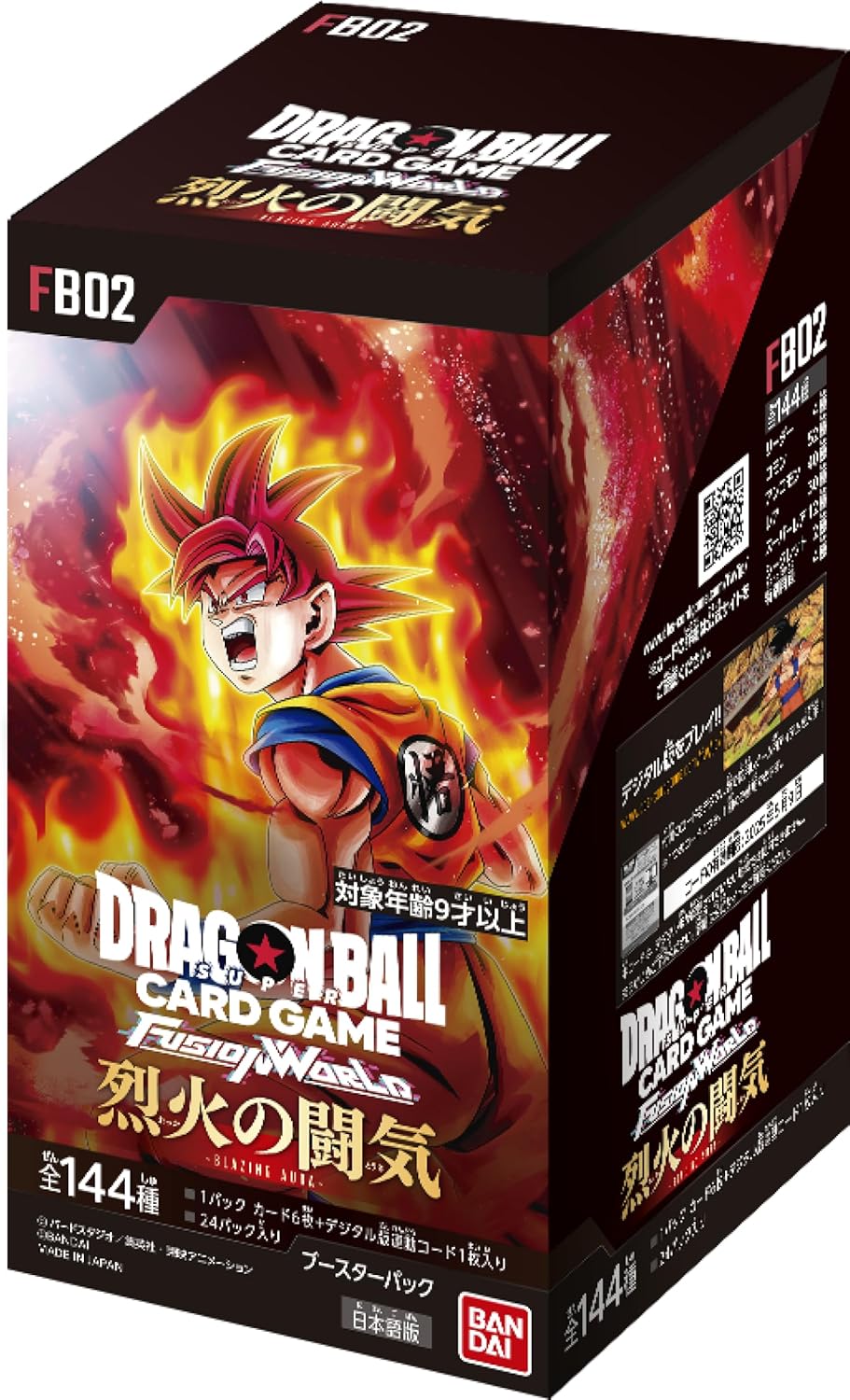
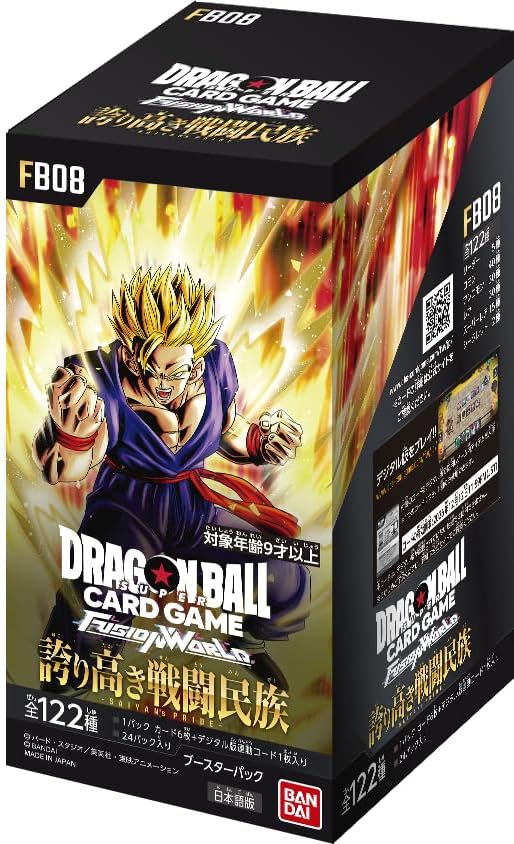
2. Set names get lost (or reworded) in translation on import listings. BANDAI’s actual English localized name and the literal machine-translated title you’ll see on Japan-focused shopping sites frequently don’t match, and this trips up buyers constantly. A few confirmed examples: FB02 is officially “Blazing Aura” in English, but shows up on Japan-export listings under the literal translation “Fiery Fighting Spirit.” FB03 is officially “Raging Roar,” but often lists as “Roar of Rage.” FB08 is officially “Saiyan’s Pride,” but shows up as “Proud Warrior Tribe.” Same booster, same set code (FB02, FB03, FB08), completely different marketing name depending on which storefront you’re on. Always cross-check the set code, not just the title, before you buy.
3. Japanese boxes are usually cheaper before shipping — but shipping and customs eat into that. English Fusion World booster boxes generally MSRP in the $85-$120 range in the US depending on the set. Japanese boxes direct from a Japan-based export mall run roughly ¥9,900-¥15,900 for standard mainline sets (about $67-$107 USD at typical August 2026 exchange rates), which can look like real savings — but add international shipping and any customs/import duty your country applies, and the gap often shrinks to a wash or even flips negative on a single box. It’s a much better deal when you’re importing several boxes at once to split shipping cost, or chasing a set that simply isn’t available in English yet.
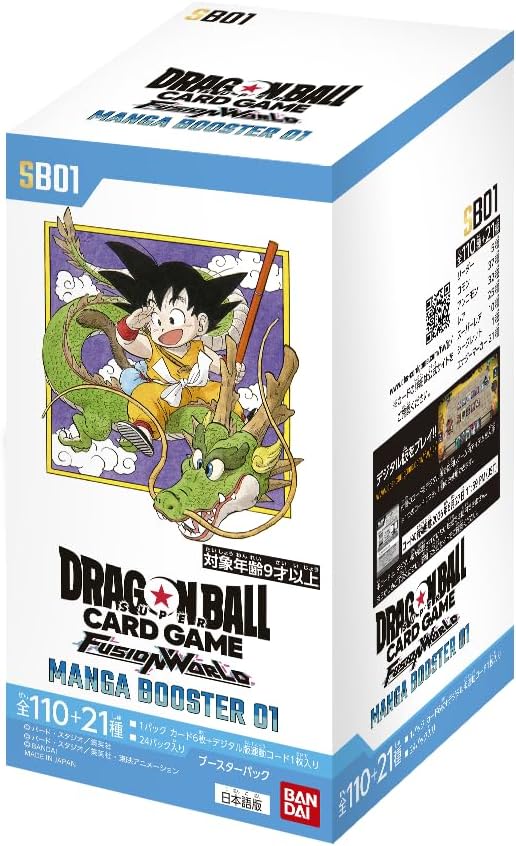
4. A few products are Japan-exclusive or Japan-first with no confirmed English equivalent. The two Manga Booster sets (SB01, SB02) reprint classic Toriyama manga panels as alt-art cards; BANDAI has released English versions of these, but they sell out fast and secondary Japanese-market pricing on SB01 in particular has climbed well above its original MSRP, reflecting collector demand for the format’s first alt-art holo run. Story Booster 01’s double-sided holographic Leaders and Dragon Ball-themed foil treatment on every Common are also a genuine format first — if you want to be first to crack that specific pull, Japanese import is currently your only option.
Where Each Version Is Legal to Play: What BANDAI Actually Says
According to BANDAI’s own “Rules of Use for Japanese Version and English Version” notice on the official Fusion World site, the two print runs are approved for use in specific regions: the Japanese version is designated for Japan, Hong Kong S.A.R., Taiwan, Singapore, Malaysia, Indonesia, the Philippines, and Thailand, while the English version is designated for North America, Latin America, Europe, and Oceania. That notice covers sanctioned regional legality, not the narrower question of whether a US tournament organizer will let you play a Japanese-print card alongside English-print cards in the same deck at a local or Regional-level event.
In practice, this is a “check with your TO” situation rather than a blanket yes/no. Plenty of casual and even competitive US playgroups are fine with a fully Japanese deck (or a deck with a handful of Japanese proxies for cards not yet released in English) as long as opponents can verify the card via a card database when needed, since the icons for Power, Cost, and Color are legible either way. Some official BANDAI-sanctioned events are stricter and may require English-region product for anything beyond casual play. If you’re building specifically to compete at a Regional or higher, don’t assume Japanese-print cards will be waved through — confirm with the event’s official rules packet first.
Real Japanese Fusion World Product You Can Actually Import
This is where a Japan-to-overseas export mall like Discovery Japan Mall is genuinely useful rather than just a novelty — it stocks real, current Japanese-print Fusion World sealed product and ships it internationally. Prices below are what the mall shows as of August 2026; treat the USD conversion as approximate since exchange rates move daily, and none of this is financial advice — sealed box pricing on any TCG shifts fast around new set releases.
| Set / Product | Code | Approx. Price (JPY) | Approx. USD | Notes |
|---|---|---|---|---|
Blazing Aura Booster Box |
FB02 | ¥9,895 | ~$67 | Listed on the mall under the literal title “Fiery Fighting Spirit” — same set |
Raging Roar Booster Box |
FB03 | ¥10,183 | ~$69 | Budget entry point; most FB03 chase cards are no longer meta-relevant |
New Adventure Booster Box |
FB05 | ¥12,152 | ~$82 | Mid-cycle mainline set |
Looming Threat Booster Box |
FB06 | ¥9,895 | ~$67 | |
Wish for Shenron Booster Box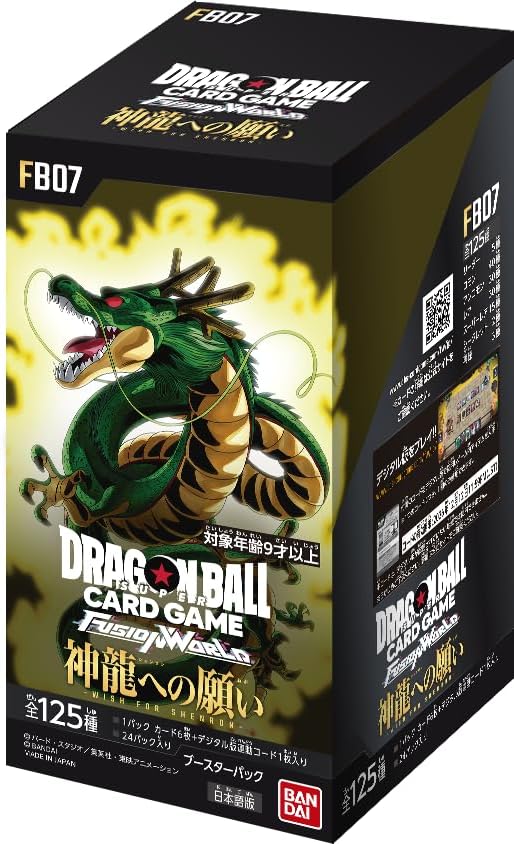 |
FB07 | ¥15,872 | ~$107 | Higher price reflects stronger demand at time of writing |
Saiyan’s Pride Booster Box |
FB08 | ¥12,375 | ~$84 | Newest mainline set this mall currently stocks; still standard-legal |
Manga Booster 01 |
SB01 | ¥50,691 | ~$343 | First alt-art manga panel set; price reflects strong collector demand, not MSRP |
Manga Booster 02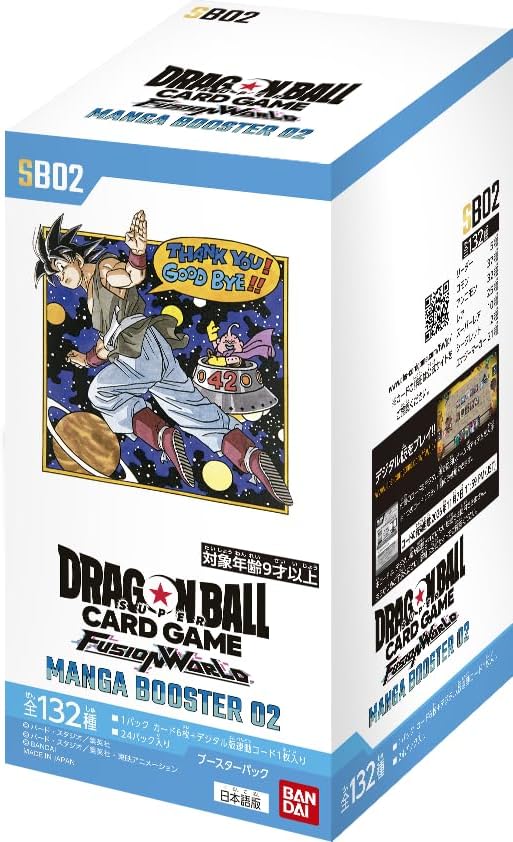 |
SB02 | ¥36,952 | ~$250 | Same format, slightly more available than SB01 |
Start Deck Bardock |
FS05 | ¥2,177 | ~$15 | Cheapest way to get a playable 51-card deck in hand |
Start Deck EX Shallot |
FS09 | ¥8,930 | ~$60 | Includes 4 SR cards out of the box |
Start Deck EX Giblet |
FS10 | ¥5,541 | ~$37 | Same EX-tier SR inclusion as FS09 |
Start Deck EX Evolutionary State |
FS11 | ¥3,855 | ~$26 | Officially “Starter Deck EX The Phase of Evolution” per BANDAI — same code, different translated title |
Note what’s missing: this mall’s current stock tops out around FB08, and doesn’t yet carry FB09 “Dual Evolution,” FB10 “Cross Force,” or the newly released Story Booster 01 (ST01) as of this writing — inventory turns over regularly, so check back if a specific set isn’t showing. Also worth flagging as a downside: none of this is singles. If you’re chasing one specific SR or SCR chase card rather than a sealed box, this kind of export mall generally isn’t the right tool — you’d be looking at singles marketplaces instead, where counterfeit risk on high-value chase cards from unverified sellers is a real and well-documented problem in this hobby. Sealed box product carries much lower counterfeit risk than loose singles bought sight-unseen.
If you’re brand new to Fusion World and haven’t decided which language or format to start with at all, our Fusion World beginner’s guide covers the basic rules and starter-deck-vs-booster-box decision in more depth.
Frequently Asked Questions
Do Japanese and English Fusion World cards have different card text or abilities?
No — the ability text is translated, not changed. A given card number has identical Power, Cost, Color, and Skill effect in both languages; only the printed language and, occasionally, minor localization wording differ.
Can I use Japanese-print cards at an English-language tournament?
It depends on the event. BANDAI’s official regional-use notice designates the Japanese version for Japan and several Asian markets and the English version for North America, Europe, Latin America, and Oceania, but that notice doesn’t spell out deck-mixing rules for every local event. Casual play and many local tournaments are lenient about Japanese-print cards as long as opponents can verify effects via a card database; official BANDAI-sanctioned Regionals and above may be stricter. Always confirm with your specific tournament organizer before building around imported cards.
Are Japanese Fusion World cards actually cheaper than English ones?
Often yes on the sticker price — Japanese mainline booster boxes typically run ¥9,900-¥15,900 (roughly $67-$107 as of August 2026) versus $85-$120 MSRP for English boxes — but international shipping and any customs duty can close or even reverse that gap on a single box. It tends to make more financial sense when ordering multiple boxes at once or chasing a set with no English release yet.
Why would I want Japanese cards if I don’t read Japanese?
The biggest reason is timing — Japan gets every new set first, sometimes by only a few days (as with Story Booster 01 in August 2026) but historically by up to ten weeks (FB01). Collectors who want the newest cards immediately, or who mainly want sealed product for display/investment rather than to read every ability at the table, don’t lose much by going Japanese. If you need to read every card’s effect at a glance during a match, that’s the real tradeoff to weigh.
Where’s the safest place to buy real Japanese Fusion World product?
Stick to established import retailers or malls that specialize in shipping real Japanese product overseas, and check that the listing shows a legitimate set code (FB0X, SB0X, FS0X) rather than trusting the marketing title alone, since literal-translation titles can differ from BANDAI’s official English name for the same set. Avoid unverified marketplace listings for loose singles in particular — sealed booster boxes and starter decks carry much lower counterfeit risk than individual high-value cards from unknown sellers.
Takeaway
Japanese and English Fusion World cards are mechanically identical — the real differences are timing (Japan is always first, sometimes by only days), price before shipping (Japanese boxes are usually cheaper on paper), and whether you personally need to read the ability text at the table. If you’re chasing the newest cards the moment they exist, want alt-art Manga Booster product, or are collecting sealed boxes rather than reading Skill text mid-game, importing Japanese Fusion World product is a legitimate and often cheaper path in — just double-check your tournament organizer’s stance before building a competitive deck around it, and always verify a set code rather than trusting a translated title.
Related Articles
- Dragon Ball Super Card Game: Original vs. Fusion World
- Dragon Ball Fusion World Beginner’s Guide (2026 Edition)
- How to Buy Dragon Ball Fusion World Cards Safely (2026)
More Trading Card Game Guides
- Japanese vs English One Piece Card Game: Full Buying Guide (One Piece Card Game)
- Japanese vs. English Pokémon Cards: Should You Import? (2026) (Pokémon TCG)
Comments